The British company appointed to build Australia’s nuclear submarines says the government’s draft nuclear safety laws would allow the disposal in Australia of high -level radioactive wastes from UK submarines.
BAE Systems chief counsel made observation at committee hearing examining the government’s naval nuclear power safety bill, which is due to be pushed through Parliament after next week’s federal budget………….
Under questioing by Greens Senator David Shoebridge, BAE’s Peter Quinlivian agreed that the wording of the bill opened a pathway for the disposal of high-level British radioactive waste in Australia.
“The legislation as drafted is in language that would accommodate that scenario” he said.
Britain is yet to dispose of any of the nuclear submarines it has decommissioned since the 1980s. It estimates it won’t fully dispose of the boats, plus seven more dure to retire in coming years, until the late 2060s.
Mr Quinlivian said that BAE had not informed the British government of the prospects that Australia could legally dispose of its nuclear waste “because it didn’t immediately strike us”
The apparent loophole flies in the face of Australia’s reassurances that AUKUS won’t require us to become a dumping ground for other countries’ nuclear wastes.
Liberal Senator David Fawcett asked Defence officials in the April 22 committee hearing whether the bill could be amended to avoid unintended consequences, something that the government is understood to be open to.
In a written response, Defence conceded that a tightening of the bill’s language could be needed. It said specifying the “disposal” of only “Australian submarine” nuclear waste would be consistent with government policy, but the government would have to “carefully consider any amendment which excluded the possibility of regulatory control of the management of low level radioactive waste from UK or US submarines……………….
The Australian Radiation Protection and Nuclear Safety agency is poised to declare a site at the HMAS Stirling naval base off Perth as a low level radioactive waste management facility, but a decision on where to store high level waste from Australia’s planned nuclear submarines is years if not decades away
Defence Minister Richard Marles said that after the government announced its nuclear submarine plans in March 2023, Australia would not take nuclear waste from its AUKUS partners
“We’re not talking about establishing a civil nuclear industry, nor are we talking about opening Australia up as a repository for nuclear waste from other countries” he told the ABC.
Senator Shoebridge said that British bureaucrats were almost certainly “rubbing their hands together at the prospect of the Albanese government being foolish enough to pass this bill”
“Minister Marles has now been embarrassed by not only his own department but the very people he signed up to make the nuclear subs” he said.
The Senate standing committee on foreign affairs defence and trade is to release its report on the Australian Naval Nuclear Power Safety Bill 2023 on May 11.
An ABC report on nuclear energy presented a one-sided viewpoint, dominated by the pro-nuclear lobby, writes Noel Wauchope.
ON 4 APRIL, on ABC’s 7.30, regional affairs reporter Jane Norman presented a sort of debate on nuclear power for Australia. An accompanying article was also published on 2 April as a debate about ‘a generational divide’.
The show was quite gripping, with excellent visual snippets of Australia’s history of nuclear issues and promotional visualisation of the industry’s proposed new small modular reactors (SMRs).
The essence of this debate seemed to be that old people are inclined to oppose nuclear power, but young people see it as a new and valuable way to reduce carbon emissions and counter global heating.
In discussing the pros and cons of nuclear power, Norman, herself relatively young, mentioned some recent opinion polls in which public opinion was split, with younger Australians being more supportive of nuclear.
In opposition to nuclear, elderly Indigenous Aunty Sue Haseldine gave an intensely personal history, passionately setting out her concern for the environment and for the children of the future. We learned, as the programme went on, that older generations had been influenced by the history of past atomic tests in Australia, and by past accidents overseas, and had developed a distrust of nuclear power.
And, presently, the Liberal Coalition Opposition, led by Peter Dutton, is putting nuclear ‘at the centre of its energy policy’.
Moving on to those supporting nuclear power, Jane Norman interviewed the enthusiastic Helen Cook.
Cook is deeply involved in the pro-nuclear lobby as principal of GNE Advisory, whose website states:
‘Helen is recognised as a nuclear law expert by the International Atomic Energy Agency [and] the former Chair of the World Nuclear Association’s Law Working Group…’
She is definitely a nuclear promoter and a favoured speaker for the industry, along with luminaries such as Michael Shellenberger, Zion Lights and Dr Adi Paterson. She said that she had had trouble overseas trying to explain Australia’s ban against nuclear power, but now back in Australia, did not find negative attitudes towards it.
We then heard very limited support from the Grattan Institute‘s Tony Wood. He was clear that at present the economics for nuclear power are “terrible”, but said that SMRs could be an option for the future. (BHP, a big uranium miner, is a big backer of the Grattan Institute.)
The programme reinforced the message for small nuclear power, showing attractive graphics of SMRs prominently marked with text: ‘Reliable, cost-effective, clean and safe.’
Then came Mark Ho, nuclear engineer and president of the Australian Nuclear Association, on the need to overturn the legislation banning nuclear. Construction of SMRs would take from three to five years.
The International Atomic Energy Agency (IAEA) says that a country could go from considering nuclear energy to having nuclear energy in its power grid in ten to 15 years
Associate Professor Edward Obbard, the head of nuclear engineering at UNSW, was the final pro-nuclear expert. He explained that there is, among young people, very little opposition to AUKUS nuclear submarines. Younger generations regard climate change as the greatest threat, so nuclear could be one of the solutions. Obbard sees it as a moral case — an environmentally low-impact way to decarbonise.
Helen Cook has interesting insights. She says that Australia has expertise in nuclear power — a questionable claim when it is based on just the staff of one small research reactor. She argues that the USA, Japan and Ukraine have experienced severe nuclear accidents, yet have pledged to treble their nuclear energy production by 2050. One does wonder why.
This is problematic, as all three countries are burdened with nuclear waste and the industry now promises the reactors that might “eat the waste” (itself a dodgy claim). The UK government now admits that the nuclear weapons industry is the real reason for civil nuclear reactors. Her case for nuclear power for Australia seems to boil down to if others are doing this, so should we.
So we have on one side a little old (very articulate and eloquent) Indigenous lady, who probably does not have a university degree, let alone a big job in the industry, versus four “highly qualified” prestigious members of the pro-nuclear lobby.
And there’s another dimension, now. The programme depicted Aunty Sue Haseldine as an admirable person, with genuine concern and emotion. But she hasn’t got the facts, the new young expert technical facts that appeal to today’s young people.
But 7.30 didn’t really present the facts. The gee-whiz SMRs are not new and young. They were tried out in the 1940s to 1960s but turned out to be uneconomic, time-consuming, gave poor performance and produced toxic wastes. The programme glossed over important issues such as waste problems, genuine study of the probable delays before SMRs could be operational, safety issues, risks of terrorism and weapons proliferation.
The ABC has a pretty noble history of tackling tough issues. And so does Sarah Ferguson, presenter of 7.30. I think they let us down this time and hope they will rectify this.
Locals who live in areas earmarked for nuclear reactors have delivered a blow to Peter Dutton’s energy plan. James Campbell National political editor, April 7, 2024, The Sunday Telegraph https://www.adelaidenow.com.au/news/nsw/peter-dutton-to-press-ahead-with-nuclear-despite-opposition-in-regional-australia/news-story/53a7108e83484542ee99870d5002fba9 Peter Dutton will press on with his plans for nuclear power, despite recent Coalition research finding widespread opposition to the proposals in regional areas earmarked for reactors. Coalition sources said focus group research carried out in the Hunter Valley in NSW and the Latrobe Valley in Victoria in recent weeks found hostility to the proposed polices. It found that while voters were aware of the general arguments for nuclear power, they were hostile to plans for reactors in their own areas.
A Coalition source familiar with the research said the findings had come as a shock. “They had convinced themselves that people would be queuing up for these things,” the source said. Another said it was clear “more work needs to be done” on winning the argument. But Mr Dutton is still set to release his plan for net-zero energy before the May budget. The Weekend Australian reported the Coalition’s plan would offer heavily discounted power bills to communities with nuclear power plants. It also reported the plan is to install small nuclear reactors at as many as seven sites, which will be operating by the mid-2030s.
“The ability to produce zero-emissions baseload with 24/7 electricity to firm up renewables is within our grasp,” he told the paper. However a Coalition MP who strongly supports nuclear power said there was increasing concern in both the Liberal and National Party rooms that it was already too late to win the public argument about nuclear power in the time left before the next election. “We haven’t even seen the policy yet,” the MP said. “My read is they’re in panic about it. They don’t know what to do.”
The Sunday Telegraph spoke to a number of Coalition MPs, including frontbenchers, who expressed concerns about the saleability of nuclear power from opposition. But they all agreed Mr Dutton is not for turning on ¬nuclear power. According to one frontbencher who supports the plan “the best case scenario” from pushing nuclear power would be a “nil-all draw” with the Government. “Let’s not kid ourselves that this is some kind of vote-catching policy,” the frontbencher said. But he said there was no chance Mr Dutton would walk away from it.
“He’s obsessed with this nuclear thing – obsessed with it,” the frontbencher said. “Peter is very determined to go down this path,” another said. On Wednesday, Mr Dutton told reporters: “I think we need to have a proper, mature discussion about how we migrate to a new energy system where we can have renewables that are firmed up by zero emissions, latest generation nuclear technology”. He added: “In terms of regions, we’ve been very definite in our advice that we’re looking at about half a dozen sites, on brownfield sites, those where you’ve got a coal-fired generator coming to an end of life”.
State politicians from across the political spectrum have rejected the federal Liberal Party’s push for nuclear power, citing cost, speed and technology as reasons to bet on renewables.
Despite being “open to the debate”, South Australian Premier Peter Malinauskas said nuclear power wasn’t fit for Australia’s energy needs.
“Every single objective, independent analysis that has looked at this has said nuclear power would make power more expensive in Australia rather than cheaper,” he told ABC News.
“Why we would impose that burden on power consumers in our country is completely beyond me. Maybe one day in a hundred years time nuclear technology might evolve.”
Labor premiers have unanimously rejected the nuclear energy push from Dutton, while influential Liberal state politicians have rejected Dutton’s energy policy.
Liberal dissent
Matt Kean, a former energy minister and treasurer in Dominic Perrottet’s NSW government, has resigned from a Liberal and National Party member-run renewable energy advocacy group because it supported nuclear energy over wind and solar.
“The reality is there is no feasible pathway [for nuclear energy] to play any material role in helping Australia replace our coal-fired power stations in line with the climate science,” Kean said.
“Large-scale nuclear reactors have proven costly and slow to deliver and [I] would refer you to the UK experience with the Hinkley Point C power station, and the fact that small modular nuclear reactors are not currently commercial anywhere in the world.”
The federal government is seeking to employ a highly skilled PR team to manage likely outrage over possible sites for a nuclear waste dump.
In new documents, released quietly on the federal tender site, the Albanese government has called for urgent expressions of interest in public relations services as it continues “high outrage” plans to build a secure nuclear waste storage facility. A major government approach to market uncovered by The Canberra Times reveals a nuclear-specific crisis management team is now being sought to bid for a two-year contract to help manage public discussion of nuclear waste in Australia.
It comes six months after the government abandoned plans for a low-level nuclear waste facility in remote South Australia amid community division including opposition from the area’s traditional owners, the Barngarla people.
It also comes as Australia, like AUKUS partners the United States and the United Kingdom, continues to be without a long-term solution for radioactive waste disposal.
The approach to market, posted on March 26, reveals the Department of Industry, Science and Resources seeking “nuclear-specific” public relations and professional communications services to work with staff from the Australian Radioactive Waste Agency (ARWA) to support the public’s “comprehensive understanding of the nation’s radioactive waste inventory, origins and need for safe management.”
“This is a highly specialised high-outrage area and there are times of uplift where urgent assistance is required and additional industry-relevant specialist support is needed, including upskilling staff to undertake these activities in a high outrage environment,” the document reads.
“The contract procurement is being undertaken at this time as these skills are especially relevant during the early stages of a new radioactive waste management approach being identified (i.e the first three-five years for a 100-year radioactive waste management project).” Last August, the federal government scrapped plans to build the nation’s first radioactive waste storage facility on farmland near Kimba in South Australia.
There was high criticism of the way the site at Napandee, a 211-hectare property at the top of the Eyre Peninsula, was announced in 2021 and then argued as needed.
The Barngarla people had earlier won a Federal Court case, successfully arguing that they were not properly consulted by the Morrison government over the site’s selection. However, some other Kimba residents were disappointed that the nuclear waste facility plans were dumped.
The Albanese government said, in scrapping the Kimba plans, that it respected the court’s decision to set aside the 2021 site declaration. The new approach to market refers to a need to engage with “impacted communities” and hold “stringent preparation for technical and challenging questions from the public to ensure ARWA can answer questions and address concerns transparently.”
“Services will include nuclear-specific stakeholder engagement, often in person, with impacted communities, nuclear industry stakeholders and the broader public – to support a comprehensive understanding of the nation’s radioactive waste inventory, origins and need for safe management,” the documents read.
The new approach to market asks that the successful suppliers be able to obtain baseline security clearance and demonstrate experience and understanding of the nuclear and radioactive industry.
According to the documents, the contract for services, which potential suppliers have to bid for over the next two weeks, would be from July 1, 2024 to June 30, 2026, with a possibility of extension. It is advised that the contract would not be fixed price irrespective of the hours spent by personnel. “Intensive” short notice work is required combined with some intrastate and interstate travel.
It warns there may be “urgent uplift from government announcements or other factors.”
The documents describe activities for the successful supplier, including engagement with the public and capability to “advise on emerging best practice for high outrage management and crisis communication and upskill APS (Australian Public Service) staff to deliver.”
They also ask that the successful supplier assist in preparing “factually correct nuclear technology and radioactive waste engagement materials ahead of in-person stakeholder engagement and upskilling APS staff.”
The Canberra Times sought comment from Resources Minister Madeleine King over the approach to market.
“Federal Resources Minister Madeleine King has instructed her department to develop policy options for managing Commonwealth radioactive waste into the future and this work is ongoing,” a spokesperson for Ms King said in a statement.
“The government has been firm in the need for the Commonwealth to safely manage its own radioactive waste.”
In its 2018 policy platform, Labor committed to signing and ratifying the TPNW in government, after taking account of a number of factors, including the new treaty’s interaction with the longstanding non-proliferation treaty.
It was Albanese who moved the motion, stating at the time, “Nuclear weapons are the most destructive, inhumane and indiscriminate weapons ever created. Today we have an opportunity to take a step towards their elimination.”
The motion was seconded by the now defence minister, Richard Marles, and adopted unanimously.
The Saturday Paper, 30 Mar 24
In August 1939, a month before the outbreak of World War II, Albert Einstein wrote to then United States president Franklin D. Roosevelt advising that a large mass of uranium could be used to make “extremely powerful bombs of a new type”.
Fearing Nazi Germany would be the first to develop such weaponry, he implored Roosevelt to speed up experimental work aimed at harnessing the destructive power of the atom.
It was, he later said, the “one great mistake” of his life.
Like J. Robert Oppenheimer, Einstein became increasingly alarmed at the implications of the Manhattan Project. In just a few years, the human species had acquired the means to destroy itself, along with most other living organisms on Earth.
Horrified by the high death toll from the US atomic bombings of Hiroshima and Nagasaki in 1945, which killed more than 200,000 people, mostly civilians, Einstein reflected, “The unleashed power of the atom has changed everything save our modes of thinking, and we thus drift toward unparalleled catastrophe.”
Shortly before his death in 1955, Einstein signed a manifesto with other renowned intellectuals, including the mathematician and philosopher Bertrand Russell, warning “a war with H-bombs might quite possibly put an end to the human race”.
Their growing concern stemmed, in part, from the discovery that nuclear weapons could spread destruction over a much wider area than had initially been supposed.
A year earlier, at Bikini Atoll in the Marshall Islands, America’s infamous Castle Bravo nuclear weapons test had poisoned not only the people of nearby Rongelap but also Japanese fishermen hundreds of kilometres from the blast site.
It was the largest of more than 300 US, French and British nuclear test explosions carried out in the Pacific between 1946 and 1996, with devastating consequences for local populations and the environment.
The British government also tested nuclear weapons on Australian soil in the 1950s and 1960s, poisoning the environment, dislocating and irradiating Aboriginal communities, and affecting many of the 20,000 British and Australian service personnel involved in the testing program.
The toxic legacy of these experiments – in Australia, the Pacific and other parts of the world – persists to this day. Those exposed to radiation and their descendants suffer from birth defects and cancers at much higher rates than the general population.
Still, the nuclear arms race continues apace. The dire warnings articulated so powerfully in the Russell–Einstein manifesto seven decades ago remain just as relevant today.
Our world is teetering on the brink of catastrophe, with close to 13,000 nuclear weapons in the arsenals of nine countries. The risk of their use – whether by accident or design – is as high as ever……………………………………………………………
Australia’s plan to acquire nuclear-powered submarines under AUKUS has only exacerbated tensions, eroding well-established non-proliferation norms.
Last year, more than 150 medical journals, including The Lancet and the Medical Journal of Australia, put out a joint call for urgent action to eliminate nuclear weapons. They identified the abolition of nuclear weapons as a public health priority. “Even a ‘limited’ nuclear war involving only 250 of the 13,000 nuclear weapons in the world,” the warning stated, “could kill 120 million people outright and cause global climate disruption leading to a nuclear famine, putting two billion people at risk.”……………………………………………………………………………………………………………..
This week, as I walked the halls of Parliament House to advocate for Australia’s signing of the Treaty on the Prohibition of Nuclear Weapons (TPNW), a landmark accord adopted at the United Nations in 2017 with the backing of 122 countries, I was reminded of the power that people in government have to make real and long-lasting change, and also how all too often they let opportunities slip by.
During my nine years as the Labor member for Fremantle, I saw how government action and policy change could make positive differences for people and the environment, but also how inaction could have devastating consequences.
The Albanese government has an opportunity to leave a powerful legacy and help secure the future of all life on Earth. To do so, Australia must step out from under the shadow of the nuclear umbrella and sign the Treaty for the Prohibition of Nuclear Wespons (TPNW)
The sticking point for Australia has been the doctrine of extended nuclear deterrence, a feature of our defence strategy for decades. In theory, Australia relies on US nuclear weapons to defend us against nuclear attack. Washington, however, has never made a public commitment to that effect. Furthermore, since nuclear deterrence is based on the willingness and readiness to commit the mass murder of civilians, it is morally and legally unacceptable, even by way of retaliation.
Deterrence theory also assumes complete rationality and predictability of all actors, including one’s enemies, all of the time, which is a bold assumption.
There are many things that cannot be deterred, including accidents, miscalculations, unhinged leaders, terrorist groups, cyber attacks and simple mistakes. There have been many nuclear near-misses over the decades and we have been on the brink of catastrophe more than once, most famously during the Cuban Missile Crisis in 1962.
The TPNW provides a pathway to the elimination of nuclear weapons. It is a new norm in international law that delegitimises and stigmatises the most destructive and inhumane weapons ever created. It also includes groundbreaking provisions to assist communities harmed by nuclear use and testing and to remediate contaminated environments.
Indonesia, New Zealand, Malaysia, the Philippines, Thailand and nine of the Pacific Island states have signed up. We are clearly out of step with our region.
Australia has a proud history of championing nuclear disarmament, particularly under Labor governments. The late Tom Uren, a Labor luminary and mentor to Anthony Albanese, was one of the party’s most passionate critics of nuclear weapons and war.
It was under the Whitlam government, with Uren serving as a minister, that Australia ratified the Treaty on the Non-Proliferation of Nuclear Weapons in 1973. Bob Hawke worked with Pacific neighbours to develop the South Pacific Nuclear Free Zone Treaty in 1985. Paul Keating established the Canberra Commission on the Elimination of Nuclear Weapons in 1995. Kevin Rudd established a follow-up commission in 2008.
In its 2018 policy platform, Labor committed to signing and ratifying the TPNW in government, after taking account of a number of factors, including the new treaty’s interaction with the longstanding non-proliferation treaty.
It was Albanese who moved the motion, stating at the time, “Nuclear weapons are the most destructive, inhumane and indiscriminate weapons ever created. Today we have an opportunity to take a step towards their elimination.”
The motion was seconded by the now defence minister, Richard Marles, and adopted unanimously.
Albanese argued the most effective way for Australia to build universal support for the TPNW – including, ultimately, bringing nuclear-armed states on board – would be for our country to join the treaty itself.
He also said that doing so would not jeopardise Australia’s alliance with the US, noting Australia had joined other disarmament treaties to which the US isn’t a party, including those banning anti-personnel landmines and cluster munitions.
New Zealand, the Philippines and Thailand have all ratified the TPNW, with no disruption to their ongoing non-nuclear military cooperation with the US. Indeed, the Philippines recently almost doubled the number of its military bases available to US forces and conducted joint military exercises with the US in the South China Sea.
Labor reaffirmed its commitment to signing the TPNW at its 2021 and 2023 national conferences, but the Albanese government has not yet inked the accord. It is time for the prime minister to act.
The rising, existential danger of nuclear war makes it all the more important for Australia to get on the right side of history.
We need to change our modes of thinking – to use Einstein’s phrase – and dispense with old ideas about what makes us safe and secure. We must remember that disarmament is essential for our collective survival.
In their manifesto, Einstein and Russell appealed as human beings to human beings: “Remember your humanity, and forget the rest.”
The United States must give assurances that Julian Assange will not face the death penalty before judges will consider dismissing the WikiLeaks founder’s bid to bring an extradition appeal, the High Court has ruled.
Assange, 52, faces prosecution in the US over an alleged conspiracy to obtain and disclose national defence information following the publication of hundreds of thousands of leaked documents relating to the Afghanistan and Iraq wars.
In a 66-page ruling, Dame Victoria Sharp said: ‘Before making a final decision on the application for leave to appeal, we will give the respondent an opportunity to give assurances.
‘If assurances are not given then we will grant leave to appeal without a further hearing.
‘If assurances are given then we will give the parties an opportunity to make further submissions before we make a final decision on the application for leave to appeal.’
These assurances are that Assange would be protected by and allowed to rely on the First Amendment – which protects freedom of speech in the US, that he is not ‘prejudiced at trial’ due to his nationality, and that the death penalty is not imposed.
The judges said the US authorities had three weeks to give those assurances, with a final hearing potentially taking place in late May.
In her ruling, Dame Sharp said any assurances from the United States would need to include ‘that the applicant (Julian Assange) is permitted to rely on the First Amendment, that the applicant is not prejudiced at trial, including sentence, by reason of his nationality, that he is afforded the same First Amendment protections as a United States citizen, and that the death penalty is not imposed’.
Speaking after the judgment, the Australian’s wife Stella Assange described the ruling as ‘astounding’.
She said: ‘What the courts have done has been to invite a political intervention from the United States… send a letter saying ‘its all ok’. I find this astounding.
‘This case is a retribution. It is a signal to all of you that if you expose the interests that are driving war they will come after you, they will put you in prison and will try to kill you.
‘The Biden administration should not issue assurances. They should drop this shameful case that should never have been brought.’
Addressing Julian Assange’s legal ground about freedom of speech guarantees in the US, Dame Victoria Sharp said: ‘The applicant wishes to argue, at any trial in the United States, that his actions were protected by the First Amendment.
‘He contends that if he is given First Amendment rights, the prosecution will be stopped. The First Amendment is therefore of central importance to his defence to the extradition charge.’
She continued: ‘If he is not permitted to rely on the First Amendment because of his status as a foreign national, he will thereby be prejudiced, potentially very greatly prejudiced, by reason of his nationality.’
Dame Victoria concluded: ‘It follows that it is arguable that the applicant might be treated differently at trial on the grounds of his nationality.
‘Subject to the question of whether this could be addressed by means of an assurance from the respondent, we would grant leave to appeal.’
WikiLeaks initially reacted positively to the news, saying Assange had been granted ‘leave to appeal’ his extradition, but he will only be allowed to do so if ‘assurances’ are not met.
Reacting to the ruling on X, formerly Twitter, this morning, WikiLeaks posted: ‘Julian Assange has been granted leave to appeal extradition to the US.
‘Having spent almost five years detained at the UK’s most secure prison the publisher will continue his long detention separated from his young family for revealing war crimes. #FreeAssangeNOW.’
WikiLeaks has now deleted this tweet.
WikiLeaks later added: ‘The court has given US Gov 3 weeks to give satisfactory assurances: That Mr. Assange is permitted to rely on the First Amendment to the US constitution; not prejudiced at trial by reason of his nationality; and that the death penalty is not imposed. #FreeAssange.’
The hearing at the Royal Courts of Justice today was attended by Assange’s wife Stella, dozens of journalists and members of the public, with hundreds observing remotely.
Dozens of people stood outside the central London courthouse to await the judgment, holding placards bearing the message ‘Free Julian Assange’ and chanting ‘There is only one decision, no extradition’.
Speaking at a press conference after Julian Assange’s bid to appeal against extradition to the US was delayed, Jennifer Robinson, WikiLeaks legal counsel, said the decision raised ‘fundamental concerns about free speech’.
She added: ‘It is absurd that we are five years into this case and the US has not offered assurance to protect him from (the death penalty).’
Ms Robinson added: ‘The judgment today demonstrates that if Julian was extradited to the United States there is a real risk and concern that he would not be afforded free speech protections.
‘We say the US should not be offering assurance in response to this judgment, they should be dropping the case and it is a case that should never have been brought in the first place.’
Speaking after the latest Julian Assange ruling, Michelle Stanistreet, general secretary of the National Union of Journalists, said: ‘A temporary reprieve is clearly preferable to an extradition that would have taken place in the coming days.
‘However, the conditionality around the grounds of appeal, which are contingent on the examination of US government assurances that he will not face the death penalty and has the right to free speech, mean the risks to Assange and press freedom remain stark.
‘Assange’s prosecution by the US is for activities that are daily work for investigative journalists – finding sources with evidence of criminality and helping them to get their stories out into the world.
‘If Assange is prosecuted, free expression the world over will be damaged.’
She added: ‘The nuanced nature of this appeal judgment makes an alternative ending to this situation even more pressing.
‘In recent months there has been increasing speculation about some kind of plea deal, to bring this saga to a swift and straightforward conclusion. I urge the US to return to these options.
‘Media freedom is under threat all over the world, compassion and common sense from the US Department of Justice would do much to restore Washington’s reputation as a bastion of free expression.’
Former Labour leader Jeremy Corbyn has called for the US to drop the charges against Julian Assange.
Speaking outside the Royal Courts of Justice, Mr Corbyn said Tuesday’s decision was ‘big step forward’ for Assange’s case but that it is ‘not the victory’ his supporters are looking for.
Mr Corbyn said: ‘Above all, the pressure has to be on the US administration to drop the charges against Julian Assange.
‘He’s a brave journalist who tells the truth.’
When asked why Assange’s case was important to him, the Corbyn said: ‘Because he’s told some very uncomfortable truths about the military activities in Iraq and Afghanistan and other places around the world, but also the effects of corporate greed on the natural world and environment.
‘If Julian goes down for that, then every serious journalist around the world is going to be feel a bit constrained, and that’s dangerous.’
n a January 2021 ruling, then-district judge Vanessa Baraitser said that Assange should not be sent to the US, citing a real and ‘oppressive’ risk of suicide, while ruling against him on all other issues.
But later that year, US authorities won their High Court bid to overturn this block, paving the way towards Assange’s extradition.
During a two-day hearing in February, lawyers for the 52-year-old asked for the go-ahead to challenge the original judge’s dismissal of other parts of his case to prevent his extradition.
And in a judgment today, Dame Victoria Sharp and Mr Justice Johnson dismissed most of Assange’s legal arguments but said that unless assurances were given by the United States, he would be able to bring an appeal on three grounds.
The judges said the US authorities had three weeks to give those assurances, with a final decision to be made in late May.
At the start of Assange’s bid last month, Mark Summers KC argued the US’s prosecution would be retribution for his political opinions, meaning it would be unlawful to extradite him under UK law.
However the two judges rejected this argument.
Dame Victoria said: ‘The applicant’s case before us amounts simply to a reassertion of his case on this issue, and a disagreement with the (district) judge’s conclusion.
‘It does not engage with the judge’s reasoning. Far less does it identify any flaw in her factual conclusions.’
First, Australia must restore a reputation tainted by blindly following America into lethal adventures in Iraq, Afghanistan and, today, via its active and crucial complicity in Israel’s deliberate war crimes in Gaza, East Jerusalem and the West Bank.
Children are not starving in Gaza today. No, they are being deliberately starved. Without hesitation or remorse. The famine in Gaza is no collateral damage. It is an intentional policy of starving to death thousands until the rest agree to leave their ancestral homeland.
Second, Australia has a duty to de-escalate the New Cold War. To understand that this can only be done if Australia ends its servility to a United States’ actively creating the threats that they then make us pay through the nose to protect us from.
Imagine an Australia that helps bring a just Peace in Ukraine, as opposed to a mindless forever war. A non-aligned Australia that is never neutral in the face of injustice but, also, not automatically aligned with every warmongering adventure decided in Washington.
Imagine an Australia which, having re-established its credentials as a country that thinks and acts for itself, engages with China in the spirit of peaceful cooperation – a far better way of addressing Beijing’s increasing authoritarianism toward its own peoples than buying useless, hyper-expensive submarines that only succeed in forcing China’s political class to close ranks around a more authoritarian core.
Imagine a truly patriotic Australian Prime Minister who tells the American President to cease and desist from the slow murder of Julian Assange for the crime of journalism – for exposing American war crimes perpetrated behind the back of US citizens in their name.
To conclude, if Europe and Australia are to escape gross irrelevance, we need separate but well-coordinated European and Australian Green New Deals.
DiEM25, our paneuropean movement, is working toward this goal.
Europe and Australia are facing a common existential threat: a creeping irrelevance caused, on the one hand, by our failure properly to invest and, on the other hand, by our ill-considered slide from a strategic dependence on the United States to a non-strategic, self-defeating servility to Washington’s policy agenda.”
Yanis Varoufakis’s address at the National Press Club in Canberra on Wednesday 13 March, 2024
…………………………………. The three post-war phases that shaped Australia’s and Europe’s habitat
Our present moment in Europe and in Australia has been shaped by three distinct postwar phases.
The first was the Bretton Woods system. America exited the war as the only surplus, creditor country. Bretton Woods, a remarkable recycling mechanism, was, in effect, a dollar zone built on fixed exchange rates, sustained by capital controls, and erected on the back of America’s trade surplus. With quasi-free trade as part of the deal, Washington dollarised Europe, Japan and Australia to generate aggregate demand for the products of its factories – whose productivity had skyrocketed during the war. Subsequently, the US trade surplus sucked the exported dollars back into America. The result was twenty years of high growth, low unemployment, blissfully boring banking and dwindling inequality. Alas, once the United States lost its trade surplus, Bretton Woods was dead in the water.
The second phase was marked by the violent reversal of this recycling mechanism. The United States became the first hegemon to enhance its hegemony by boosting its trade deficit. Operating like a powerful vacuum cleaner, the burgeoning US trade deficit hoovered up the world’s net exports. And how did America pay for them? With dollars which it also hoovered up from the rest of the world as German, Japanese and later Chinese capitalists sent to Wall Street 70% of dollar profits made from their net exports to the US. There, in Wall Street, these foreign capitalists recycled their dollar profits into Treasuries, real estate, shares and derivatives.
This audacious inverted recycling system, built on US deficits, required ever increasing American deficits to remain stable. In the process, it gave rise to even higher growth than the Bretton Woods era, but also to macroeconomic and financial imbalances as well as mind-numbing levels of inequality. The new era came complete with an ideology (neoliberalism), a policy of letting finance rip (financialisation), and a false sense of dynamic equilibrium – the infamous Great Moderation built on hugely immoderate imbalances.
Almost inevitably, on the back of the perpetual tsunami of capital rushing in from the rest-of-the-world to Wall Street, financiers fashioned gigantic pyramids of complex wagers – Warren Buffet’s infamous Weapons of Mass Financial Destruction. When these crashed, to deliver the Global Financial Crisis, two things saved Wall Street and Western capitalism:
The G7 central banks, that printed a total of $35 trillion on behalf of the financiers from 2009 to last year – a peculiar socialism for bankers. And,
China, which directed half its national income to investment, thus replacing much of the lost aggregate demand not only domestically but also in Germany, Australia and, of course, in the United States.
The third period is more recent. The era of technofeudalism, as I call it, which took root in the mid-2000s but grew strongly after the GFC in conjunction with the rapid technological change that caused capital to mutate into, what I call, cloud capital – the automated means of behavioural modification living inside our phones, apps, tablets and laptops. Consider the six things this cloud capital (which one encounters in Amazon or Alibaba) does all at once:
It grabs our attention.
It manufactures our desires.
It sells to us, directly, outside any actual markets, that which will satiate the desires it made us have.
It drives and monitors waged labour inside the workplaces.
It elicits massive free labour from us, its cloud-serfs.
It provides the potential of blending seamlessly all that with free, digital payments.
Is it any wonder that the owners of this cloud capital – I call them cloudalists – have a hitherto undreamt of power to extract? They are, already, a new ruling class: today, the capitalisation of just seven US cloudalist firms is approximately the same as the capitalisation of all listed corporations in the UK, France, Japan, Canada and China taken together!
Events. Peace! – No AUKUS, No War! Australia wide events and protest actions for Peace, end AUKUS, cancel nuclear submarines and mobilise against war 14 – 24 March
The prospect of Australia trying to build nuclear reactors at soon-to-be-closed coal plants raises many questions. Here’s what we know.
The prospect of Australia turning to nuclear power has been little more than a politically radioactive thought bubble – until the Coalition this week confirmed it wants to put reactors at the sites of soon-to-be-closed coal plants.
Energy experts have previously derided the idea, saying some of the technologies being touted did not exist, and that nuclear would be too slow, too expensive and unnecessary in a country with so much free solar and wind available to harness.
But as the Coalition promises to take a pro-nuclear policy to the next election, the prospect of Australia trying to build nuclear reactors raises many questions.
Could it even work, or would it be an economic and logistical disaster?
What’s being proposed?
The Coalition is understood to be looking at both conventional large-scale nuclear reactors and small modular reactors (SMR) which are not expected to be available commercially until the early 2030s, or potentially later.
The Coalition has said more details will come before its reply to the federal budget, expected in May.
What about timing?
The Australian Energy Market Operator’s latest draft plan to develop the national electricity market (that’s everywhere except Western Australia and the Northern Territory) says under the most likely future scenario, 90% of coal plants will have retired by 2035, with the rest gone by 2038.
That means governments and electricity generators are already having to work at breakneck speed to add enough renewable energy and storage, such as batteries and pumped hydro, to make sure Australia can meet its obligations to bring down greenhouse gas emissions while delivering the cheapest and most reliable electricity system possible.
Those decisions are being made based on the technology that is available now, and based on economics. Renewables backed up by storage are the cheapest option, according to the vast majority of experts.
The Coalition argues building reactors on the sites of old coal plants would avoid some of the costs of building new transmission lines and the storage needed to allow for the times when wind and solar production is low.
Tony Wood, the director of the Grattan Institute’s energy program, says by the time a hypothetical nuclear plant could be built and operating – which he says could be 20 years away – “the coal-fired power has been closed down and you’re in deep trouble”.
“I just think the economics and the timescales don’t fit.”……………………………………….
When could reactors be built in Australia?
A Coalition government, if elected, would have to agree regulations to govern a brand new industry and create new government institutions such as the US Nuclear Regulatory Commission to run the industry.
Dr Dylan McConnell, an energy systems analyst at the University of New South Wales, says: “Recent nuclear power projects in comparable countries have experienced considerable delays and cost overruns. There is little prospect of a conventional nuclear power plant delivering electricity before the 2040s.”
Construction on two nuclear units in the US started in 2009 and were seven years late and reportedly US$17bn (A$25bn) over budget when they started generating power last year.
In the UK, French company EDF’s 3,200MW Hinkley Point C plant began construction in 2017 and, after several revisions, the company says it may not be delivering electricity until 2031. Initial cost estimates of £18bn (A$34bn) have been revised as high as £46bn (A$89bn).
A deal to buy the electricity using a surcharge on UK customer bills has put “an albatross around the neck of UK consumers for a very long time”, says Woods.
And who would build them?
Glenne Drover, the secretary of the Victorian branch of the Australian Institute of Energy and a broad supporter of nuclear power, thinks the biggest potential block for nuclear in Australia would be finding overseas companies to actually build reactors.
At last year’s Cop28 climate talks, more than 20 countries pledged to triple nuclear power capacity by 2050. The books of many nuclear builders are filling up.
“Australia could do what the United Arab Emirates did and go out with a tender process, but who would take that up?” he asks.
“Would we be happy if one of those companies was Chinese or Russian? Kepco [a South Korean company] maybe, but could you get them?”………………………………….
Could nuclear work in Australia’s grid?
McConnell says conventional nuclear plants need to be almost constantly running to be economically viable. But as we head towards 2040, Australia’s energy system will be dominated by renewable energy and storage, such as batteries and pumped hydro.
This would be a “very challenging power system for nuclear power to economically operate in”, says McConnell.
“Some of the challenges facing the economic viability of coal generation are directly transferable to nuclear power generation.
“Low-cost renewable generation is eroding both the utilisation and market value of coal generation and would have similar effects on a nuclear generator.”
But large nuclear reactor units could also create a headache for the electricity grid. The biggest single generating source on Australia’s grid is a 750MW coal unit in Queensland.
“The typical size of conventional nuclear units today is larger than any existing coal units in the national Eeectricity market,” says McConnell. “The loss of such a single large unit represents a risk to the operation of the electricity system. This risk would need to be managed and would come at some additional cost.”
McConnell questions if the sites of old coal plants would be available to buy. “The grid connection points are valuable assets,” he says. “Old power station sites are already being developed to make use of these valuable connection points.”
What about costs?
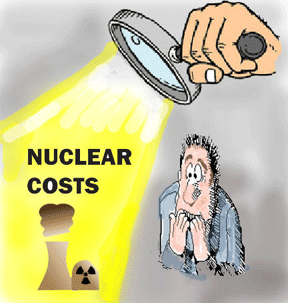
Without knowing what kind of reactors might be built, and how they would be paid for, and the price of establishing an industry, it’s difficult to know the future costs of nuclear. But it’s unlikely to be cheap.
For SMRs, the CSIRO gives a theoretical range of $382 to $636 per MWh in the year 2030, compared with $91 to $130 for wind and solar. CSIRO has so far not provided estimates for conventional nuclear but, using US data, nuclear is among the more expensive power options.
John Quiggin, a professor of economics at the University of Queensland, says without a carbon price, nuclear plants would need very large taxpayer subsidies in Australia.
He says one of the only countries to have recently started a nuclear industry is the United Arab Emirates that drew up its first nuclear policy in 2008, commissioning South Korean company Kepco to build four 1,400MW units.
Quiggin says these four reactors will likely have cost the UAE as much as $100bn – enough money to put a large solar system on the roof of every Australian house, he says.
The first of the country’s four nuclear power units came online in 2020 and a fourth is expected to start producing electricity in the coming months – all between three and four years later than expected.
That’s a 16-year process in a country that, without a democratic system, can make arbitrary decisions to get plants built. It is not a good comparison for what might happen in Australia.


 Nuclear Australia